

The most costly Fabergé eggs ever made usually are not merely jewelled objects – they’re miniature worlds of extraordinary craftsmanship, imperial historical past, and staggering value, with the rarest examples now valued at over $30 million.
We’ve got been lucky sufficient to see many of those eggs in particular person at at V&A Museum exhibition in London, and nothing fairly prepares you for the truth of standing earlier than them. The pictures don’t do justice to the dimensions of the craftsmanship – the layers of translucent enamel, the impossibly superb goldwork, the tiny mechanical surprises hidden inside every shell. They’re genuinely breathtaking objects.
On this article, we take an in depth take a look at the 24 most costly Fabergé eggs ever made – their historical past, their hidden surprises, their present estimated values, and the place they’re now. We additionally cowl the 2025 public sale document that reset the benchmark for what these extraordinary objects command at sale.
New File: In 2025, the Fabergé Winter Egg bought at public sale for $30.2 million – making it the most costly Fabergé egg ever bought at public public sale. Created in 1913 for Dowager Empress Maria Feodorovna, it’s carved from rock crystal with platinum and diamond detailing to create a frozen, icy impact.
The sale shattered earlier public sale data and underlines the persevering with rise in worth of the best Imperial eggs. We’ve got up to date all valuations on this article to replicate present 2026 estimates.
Most Costly Fabergé Eggs: Present Worth Information (2026)
All Fabergé eggs are successfully priceless – most are held in museums or personal collections and barely if ever come to public sale. The values under signify present professional estimates primarily based on the newest comparable gross sales knowledge and specialist value determinations.
| # | Faberge Egg | 12 months | Est. Worth | Present Location |
| 1 | Third Imperial Easter Egg | 1887 | ~$33 million | Personal assortment (US) |
| 2 | Winter Egg | 1913 | $30.2M (bought 2025) | Personal assortment |
| 3 | Rothschild Clock Egg | 1902 | ~$25 million | Hermitage Museum, St Petersburg |
| 4 | Coronation Egg | 1897 | ~$18-20 million | Faberge Museum, St Petersburg |
| 5 | Lilies of the Valley Egg | 1898 | ~$15-18 million | Faberge Museum, St Petersburg |
| 6 | Mosaic Egg | 1914 | ~$15-20 million | Royal Assortment, UK |
| 7 | Moscow Kremlin Egg | 1906 | ~$15-20 million | Kremlin Armoury, Moscow |
| 8 | Fifteenth Anniversary Egg | 1911 | ~$12-15 million | Faberge Museum, St Petersburg |
| 9 | Colonnade Egg | 1910 | ~$10-15 million | Royal Assortment, UK |
| 10 | Peacock Egg | 1908 | ~$8-10 million | Basis Sandoz, Switzerland |
| 11 | Alexander Palace Egg | 1908 | ~$7 million | Kremlin Armoury, Moscow |
| 12 | Gatchina Palace Egg | 1901 | ~$7 million | Faberge Museum, St Petersburg |
| 13 | Order of St George Egg | 1916 | ~$7 million | Faberge Museum, St Petersburg |
| 14 | Hen Egg (First Imperial) | 1885 | ~$6 million | Faberge Museum, St Petersburg |
| 15 | Cradle with Garlands Egg | 1907 | ~$6 million | Personal assortment |
| 16 | Yusupov Clock Egg | 1907 | ~$6 million | Personal assortment |
| 17 | Tsarevich Egg | 1912 | ~$5-7 million | Virginia Museum of Wonderful Arts |
| 18 | Diamond Trellis Egg | 1892 | ~$4-5 million | Houston Museum of Pure Science |
| 19 | Romanov Tercentenary Egg | 1913 | ~$4-5 million | Kremlin Armoury, Moscow |
| 20 | Bay Tree Egg | 1911 | ~$4-5 million | Faberge Museum, St Petersburg |
| 21 | Rosebud Egg | 1895 | ~$4 million | Faberge Museum, St Petersburg |
| 22 | Blue Serpent Clock Egg | 1895 | ~$3-5 million | Personal assortment |
| 23 | Basket of Flowers Egg | 1901 | ~$3-5 million | Royal Assortment, UK |
| 24 | Imperial Crimson Cross Egg | 1915 | ~$2-3 million | Cleveland Museum of Artwork |
Be aware: Many eggs have by no means been bought at public sale and their values are estimates solely. Personal gross sales are sometimes undisclosed. The Viktor Vekselberg buy of 9 Forbes Assortment eggs in 2004 for about $100 million stays the biggest single Fabergé transaction on document.
The 24 Most Costly Fabergé Eggs: Full Information
The eggs under are listed broadly so as of estimated present worth. The place public sale data exist, we’ve got used these as the premise for rating; the place no sale has occurred, we’ve got used professional estimates from the gemological and public sale neighborhood.
1. The Third Imperial Easter Egg – Est. $33 Million
The Third Imperial Easter Egg is taken into account by many consultants to be essentially the most worthwhile Fabergé egg in existence. Created in 1887 from 18-karat gold, adorned with sapphires and diamonds, and concealing a Vacheron Constantin girl’s watch inside, it disappeared through the Russian Revolution and was believed misplaced for almost a century.
Its rediscovery is without doubt one of the nice tales within the artwork world. In 2011, a scrap steel supplier within the American Midwest purchased the egg at a flea marketplace for roughly $14,000, aspiring to soften it down. One thing made him analysis it additional. Recognising it as a Fabergé egg, he contacted Wartski, the London supplier that has dealt with extra Fabergé gross sales than nearly anybody else. The egg was recognized and bought for an undisclosed sum believed to be within the area of $33 million.
Hidden shock: A 14-karat gold Vacheron Constantin girl’s watch with a white enamel dial and diamond-set palms.
Location: Personal assortment, United States.

2. The Winter Egg – $30.2 Million (2025 Public sale File)
The Winter Egg now holds the world public sale document for a Fabergé egg, promoting at Christie’s London in December 2025 for £22.8 million ($30.2 million) – the primary Imperial Egg to seem at public public sale in over 23 years. It was designed by Alma Pihl, one of many few ladies to work as a designer for Fabergé, who reportedly took inspiration from ice crystals forming on her workshop window.
Carved from rock crystal to simulate a block of ice, the outside is encrusted with platinum and 4,500 rose-cut diamonds organized in a snowflake motif. The shock inside is a tiny hanging basket of anemones produced from garnets, white quartz and nephrite – spring flowers hid inside a frozen shell. Nicholas II paid 24,600 roubles for it, the third-highest sum Fabergé ever charged.
Hidden shock: A miniature basket of wooden anemone flowers in white quartz, nephrite, and garnets.
Funding word: The 2025 worth far exceeded pre-sale estimates of £20 million and indicators that the marketplace for top-tier Imperial eggs stays exceptionally sturdy.

3. The Rothschild Clock Egg – Est. $25 Million
Bought at Christie’s in November 2007 for £8.9 million – a document on the time – the Rothschild Clock Egg was commissioned not for the Imperial household however by Béatrice Ephrussi de Rothschild as an engagement reward for Germaine Halphen, who was marrying into the Rothschild banking dynasty.
Constituted of pink chevron guilloche enamel, gold, and semi-precious stones, the egg is a clock – and each hour, a diamond-encrusted automaton cockerel emerges from the highest, spreads its wings, bobs its head, and crows. It’s a rare piece of mechanical theatre as a lot as jewelry.
After the 2007 sale, the egg was gifted to the Hermitage Museum in St Petersburg by Vladimir Putin in 2014, the place it stays on public show. Estimated present worth, adjusted for the 2025 Winter Egg sale, is roughly $25 million.
V&A word: The Rothschild Clock Egg was among the many highlights of the V&A’s Fabergé in London exhibition. Seeing the cockerel mechanism in particular person – even behind glass – is a kind of genuinely unforgettable museum moments. The pictures merely can’t seize the intricacy of the enamelling up shut.

4. The Coronation Egg – Est. $18-20 Million
Created in 1897 to mark the coronation of Tsar Nicholas II and Empress Alexandra, the Coronation Egg’s outer shell is roofed in yellow enamel with a trellis of black double-headed eagles set with diamonds and rubies – a reference to the imperial coronation robes.
The hidden shock took craftsman Georg Stein over fifteen months to finish: an ideal miniature reproduction of the Imperial coronation coach, correct in each element together with tiny working door handles and folding steps. There was initially a miniature diamond egg contained in the carriage, which was subsequently misplaced.
Now a part of the Fabergé Museum assortment in St Petersburg, The Coronation Egg was acquired by Viktor Vekselberg as a part of his landmark $100 million buy of 9 Forbes Assortment eggs in 2004.
Hidden shock: An ideal miniature reproduction of the Imperial coronation coach in gold and enamel.
Location: Faberge Museum, St Petersburg (Vekselberg assortment).

5. The Lilies of the Valley Egg – Est. $15-18 Million
The Lilies of the Valley Egg is without doubt one of the most delicate and personally significant of all of the Imperial eggs. Commissioned by Tsar Nicholas II for Empress Alexandra Feodorovna in 1898, it displays her specific fondness for lilies of the valley – a flower she wore at each alternative and related to purity and innocence.
The outer shell is fashioned from gold coated in translucent pink guilloche enamel, rising on 4 gold legs formed like lily-of-the-valley leaves accented with rose-cut diamonds. Vertical friezes of diamond-set lily flowers beautify the floor.
It’s now a part of the Vekselberg assortment on the Faberge Museum in St Petersburg and is estimated at $15-18 million by a number of unbiased sources.
Hidden shock: A gold heart-shaped body with three miniature portrait panels of Nicholas II, Alexandra, and Grand Duchess Olga, revealed by turning a pearl button.
Location: Faberge Museum, St Petersburg (Vekselberg assortment).

6. The Mosaic Egg – Est. $15-20 Million
The Mosaic Egg is one in every of solely three Imperial Fabergé eggs held within the Royal Assortment, and the one one to characteristic a mosaic sample. Designed by Alma Pihl – who additionally designed the Winter Egg – and produced by Workmaster Albert Holmström in 1914, it was a present from Tsar Nicholas II to Empress Alexandra.
The floor is roofed in a platinum mesh set with diamonds, rubies, emeralds, topazes, and pearls organized in a fragile floral mosaic. Inside there’s a folding display with sepia portraits of the 5 Imperial kids painted on ivory.
V&A word: The Mosaic Egg was probably the most putting items we noticed on the V&A exhibition. The density of the gem setting is astonishing in particular person – it seems nearly textile-like slightly than jewelled, which images solely fail to convey.
Hidden shock: A five-panel ivory display with miniature portraits of the Imperial kids.
Location: Royal Assortment, UK (King Charles III).

7. The Moscow Kremlin Egg – Est. $15-20 Million
The Moscow Kremlin Egg was made by an unknown craftsman in 1906 and is the biggest of all of the Imperial Fabergé eggs. It represents Moscow’s Uspenski Cathedral in extraordinary element – produced from gold, onyx, enamel, and glass, with a detachable cathedral dome that reveals an intricate church inside. It’s on everlasting show on the Kremlin Armoury Museum in Moscow.
Hidden shock: A gold music field on the base of the egg.
Location: Kremlin Armoury Museum, Moscow.

8. The Fifteenth Anniversary Egg – Est. $12-15 Million
Estimated at between $12-15 million, the Fifteenth Anniversary Egg was a present from Tsar Nicholas II to his spouse, Tsaritsa Alexandra Feodorovna, in 1911 – commemorating the fifteenth anniversary of their coronation. The egg is roofed in inexperienced and white enamel with gold and nephrite, and set with diamonds, amethysts, pearls, citrines, and rubies. It’s now owned by Viktor Vekselberg.
Location: Faberge Museum, St Petersburg (Vekselberg assortment).

9. The Colonnade Egg – Est. $10-15 Million
Crafted by Chief Workmaster Henrik Wigström in 1910, the Colonnade Egg is one in every of three Fabergé eggs now belonging to King Charles III. Tsar Nicholas II gave it to his spouse Empress Alexandra for Easter, impressed by the temple constructed for Marie Antoinette on the Palace of Versailles.
The egg incorporates a rotating clock face supported by 4 pink-enamelled columns, with 4 gold cherubs on the base representing the Emperor’s 4 daughters. The cherub on the prime symbolises the Tsarevich Alexei, and two white doves signify the Emperor and Empress.
It’s a very private object – a household portrait in miniature, encoded in allegory, disguised as a clock.
Location: Royal Assortment, UK (King Charles III).

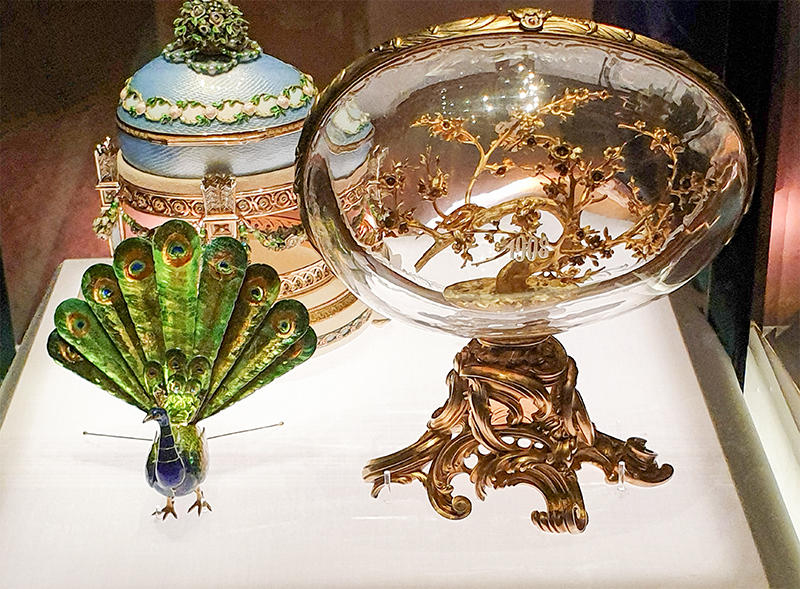
10. The Peacock Egg – Est. $8-10 Million
The Peacock Egg is among the many most technically extraordinary of all Faberge’s creations – and one of many only a few eggs held in a personal Western European basis slightly than a museum or Russian assortment. Made by Dorofeiev underneath the supervision of Faberge in 1908, it was a present from Tsar Nicholas II to his mom, Dowager Empress Maria Feodorovna.
The egg is carved from rock crystal and positioned horizontally, every half set right into a heavy gold mount. Inside, a mechanical peacock sits amid the branches of a golden tree strewn with flowers of treasured stones and enamel.
When faraway from the egg and wound, the peacock walks, turns its head, and spreads its tail in a show of iridescent colored enamel feathers. It’s owned by the Basis Edouard et Maurice Sandoz in Switzerland – which is why it’s seldom seen at public exhibitions.
V&A word: The Peacock Egg isn’t on public show. We had been lucky to see it at a Faberge exhibition on the V&A Museum in London, and the working peacock automaton is genuinely probably the most astonishing issues we’ve got ever seen in a museum context. The extent of mechanical engineering required to make a chicken that dimension stroll and unfold its tail with such precision is sort of unattainable to understand.
Hidden shock: A mechanical peacock automaton that walks, turns its head, and spreads its iridescent tail when wound.
Location: Basis Edouard et Maurice Sandoz, Switzerland (not often on public show).
11. The Alexander Palace Egg – Est. $7 Million
Constituted of Siberian nephrite – a deep inexperienced jade – set with gold, diamonds, and rubies, the Alexander Palace Egg was crafted by Henrik Wigström in 1908. The outside bears watercolour miniature portraits of Nicholas II and Empress Alexandra’s 5 kids in rose-cut diamond-bordered frames.
Inside you’ll discover an intricate mannequin of the palace and its gardens at Tsarskoye Selo – the household’s favorite residence. It’s normally on show on the Kremlin Armoury in Moscow.
Hidden shock: A miniature mannequin of the Alexander Palace and gardens.
Location: Kremlin Armoury, Moscow.

12. The Gatchina Palace Egg – Est. $7 Million
Given by Tsar Nicholas II to his mom Dowager Empress Marie Feodorovna at Easter 1901, the Gatchina Palace Egg options a number of layers of translucent enamel utilized onto mechanically engraved gold – a guilloché method that creates a shimmering, watery impact beneath the enamel floor.
Inside there’s a detailed reproduction of Gatchina Palace – the Empress’s winter residence. It’s now a part of the Fabergé Museum assortment in St Petersburg.
Hidden shock: A miniature gold reproduction of Gatchina Palace, full with timber, cannons, and a statue of Paul I.
Location: Faberge Museum, St Petersburg.

13. Order of St George Egg – Est. $7 Million
Also referred to as the Cross of St. George Egg, this masterpiece was made in 1916 for Nicholas II of Russia. It was offered as a present to his Mom, Dowager Empress Maria Feodorovna, through the First World Conflict. In contrast to most Imperial eggs, it was designed with wartime austerity in thoughts: there isn’t a enamel and no treasured stones. As a substitute, it’s produced from silver-gilt and opalescent white enamel in a comparatively restrained design.
The egg commemorates the Order of St George – a navy honour awarded to each Nicholas II and his son, the Tsarevich Alexei. Hid inside are tiny watercolour portraits of the tsar and his son.
This historic egg is now a part of the Fabergé Museum assortment in St Petersburg, acquired by Viktor Vekselberg. Its worth of round $7 million displays its historic significance as the ultimate Imperial egg as a lot as its supplies.
Hidden shock: Miniature watercolour portraits of Tsar Nicholas II and the Tsarevich Alexei.
Location: Faberge Museum, St Petersburg (Vekselberg assortment).

14. The Hen Egg (First Imperial Egg) – Est. $6 Million
The Hen Egg is the primary Fabergé Imperial egg ever made, commissioned by Tsar Alexander III in 1885. Its creation launched one of many best traditions within the historical past of jewelry. The design is deceptively easy: a white enamel shell opens to disclose a golden yolk, inside which sits a golden hen on golden straw. Initially contained in the hen had been a miniature diamond reproduction of the Imperial crown and a tiny ruby pendant – sadly each misplaced.
It price 4,151 roubles. Six weeks after presenting it, Alexander III appointed Fabergé as official jeweller to the Imperial court docket. It’s now on the Fabergé Museum in St Petersburg.
V&A word: Seeing the Hen Egg alongside the later masterpieces on the V&A was an interesting train in following the evolution of Fabergé’s ambition. The primary egg is modest by comparability to what adopted – which makes it all of the extra fascinating to face earlier than. You may see precisely why Alexander III was so delighted, and equally how shortly the next commissions escalated in complexity.
Hidden shock: A golden hen on golden straw (crown and pendant initially contained in the hen are actually misplaced).
Location: Faberge Museum, St Petersburg.

15. The Cradle with Garlands Egg – Est. $6 Million
Made by Chief Workmaster Henrik Wigström in 1907, the Cradle with Garlands Egg was commissioned by Tsar Nicholas II for his spouse Alexandra upon the delivery of their son Alexei. It’s coated in pale blue enamel and encrusted with pearls. The shock hidden inside – a miniature of the Imperial kids – is now lacking.
This egg has a selected connection to London: it was beforehand on long-term mortgage to the V&A Museum, the place many guests may have encountered it earlier than its return to its private-collection homeowners.
V&A word: We noticed the Cradle with Garlands Egg through the V&A exhibition interval. It is without doubt one of the extra intimate eggs – its pale blue colouring and pearl ornament give it a softness that the extra jewel-encrusted examples don’t have, and the story of its creation to rejoice Alexei’s delivery provides a poignant layer of context given what we all know of the Romanov household’s destiny.
Location: Personal assortment.

16. The Yusupov Clock Egg – Est. $6 Million
Crafted by Fabergé Chief Workmaster Henrik Wigström in 1907, the Yusupov Clock Egg was not made for the Imperial household however as a twenty fifth wedding ceremony anniversary reward from Prince Felix Yusupov to his spouse, Princess Zinaida. Constituted of gold, silver, gilt, diamonds, rubies, emeralds, pearls, white onyx and enamel, it is without doubt one of the most ornate non-Imperial commissions Fabergé ever produced.
The egg initially contained portraits of Felix and their two sons. The youngest son – additionally referred to as Felix – later grew to become one of many co-conspirators who murdered Grigory Rasputin in 1916. It’s at present a part of a personal assortment.
Location: Personal assortment.

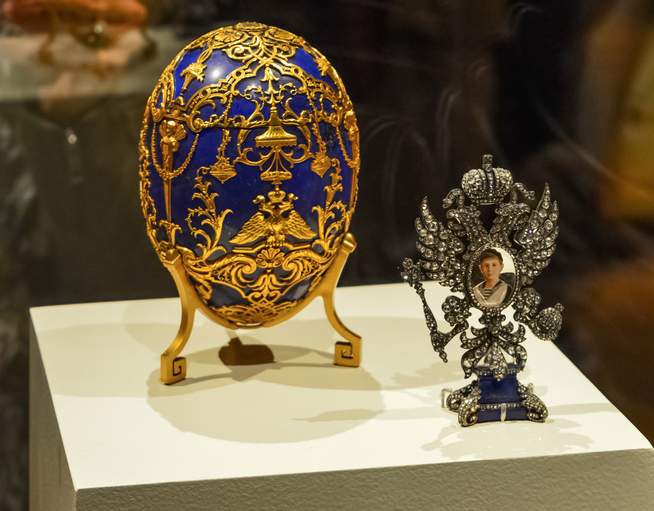
17. The Tsarevich Egg – Est. $5-7 Million
The Tsarevich Egg was crafted in 1912 by Mikhail Perkhin underneath the supervision of Faberge, and given by Empress Alexandra Feodorovna in tribute to her son, the Tsarevich Alexei. Its development is uncommon: the outer shell is produced from six sections of carved lapis lazuli – the wealthy blue stone lengthy related to imperial Russia – separated by gold lattice work within the type of double-headed eagles and set with diamonds.
On the prime of the egg sits a big flat portrait diamond, and the shock is a miniature portray by Zuiev mounted in an ornate diamond-studded body of a double-headed eagle design – a portrait of the Tsarevich Alexei himself. It’s now on everlasting show on the Virginia Museum of Wonderful Arts in Richmond, a part of the Lillian Thomas Pratt assortment.
Hidden shock: A miniature portrait of the Tsarevich Alexei in a diamond-studded double-headed eagle body.
Location: Virginia Museum of Wonderful Arts, Richmond, USA.
18. The Diamond Trellis Egg – Est. $4-5 Million
Initially costing 4,750 silver roubles, the Diamond Trellis Egg was created in 1892 for Tsar Alexander III as a present for his spouse, Empress Maria Feodorovna. Constituted of gold and the uncommon mineral jadeite – a vivid inexperienced jade – it’s encrusted with rose-cut diamonds organized in a fragile trellis sample. It’s normally on show on the Houston Museum of Pure Science.
Its shock was lengthy regarded as lacking, however was subsequently recognized within the Royal Assortment – an ivory automaton elephant adorned with gold and treasured stones. Its estimated worth of $4-5 million displays each its age as one of many earlier Imperial eggs and the distinctive rarity of jadeite as a development materials.
Hidden shock: An ivory automaton elephant adorned with gold and treasured stones.
Location: Houston Museum of Pure Science, Texas.

19. The Romanov Tercentenary Egg – Est. $4-5 Million
Created in 1913 to mark the three hundredth anniversary of the Romanov dynasty, the Romanov Tercentenary Egg is without doubt one of the most traditionally vital of all of the Imperial eggs. Its outer shell is about with 1,115 rose-cut diamonds, and portrait miniatures of the eighteen Romanov rulers from Mikhail I in 1613 to Nicholas II himself are labored into the floor.
The egg is topped with a big diamond, and the shock is a rotating globe exhibiting the territories of the Russian Empire in each 1613 and 1913, mounted on a gold stand. It was given by Nicholas II to Empress Alexandra Feodorovna and is now on everlasting show on the Kremlin Armoury Museum in Moscow.
Its comparatively modest estimated worth of $4-5 million displays the problem of pricing an egg that has by no means come to public public sale and is in institutional possession.
Hidden shock: A rotating globe exhibiting the Russian Empire’s territories in 1613 and 1913.
Location: Kremlin Armoury Museum, Moscow.

20. The Bay Tree Egg – Est. $4-5 Million
The Bay Tree Egg is among the many most enchanting automaton eggs ever made – a small gold tree hung with nephrite jade leaves, enamelled flowers, and fruits of treasured stones, concealing one in every of Faberge’s most interesting mechanical surprises. When a hidden secret is turned, a brightly colored chicken rises from the foliage, flaps its wings, strikes its beak, and sings.
Made in 1911 and given by Nicholas II to his mom, Dowager Empress Maria Feodorovna, it was later bought by the Soviets alongside many different Imperial treasures. The singing chicken mechanism requires extraordinary watchmaking precision. It’s now a part of the Vekselberg assortment on the Faberge Museum in St Petersburg.
Hidden shock: A singing chicken automaton that rises from the foliage and performs when a hidden secret is turned.
Location: Faberge Museum, St Petersburg (Vekselberg assortment).

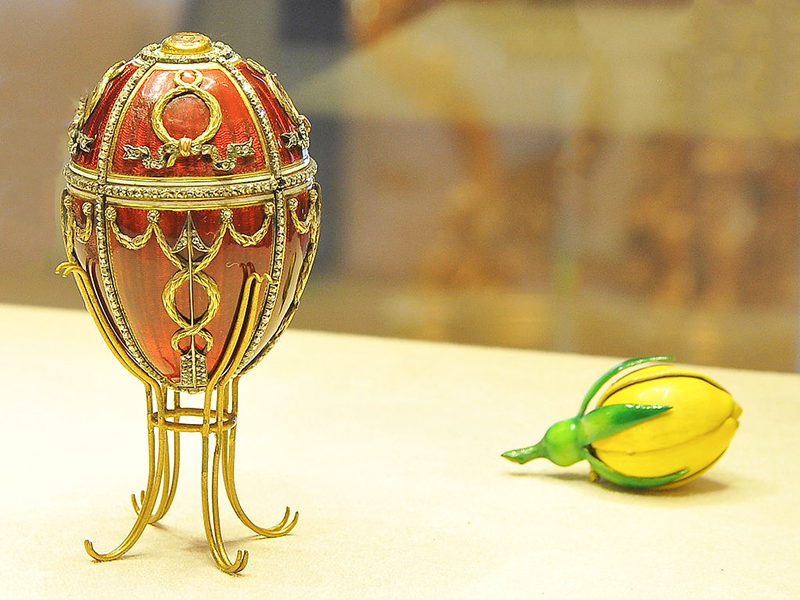
21. The Rosebud Egg – Est. $4 Million
The Rosebud Egg holds a selected significance within the Imperial assortment: it was the primary Faberge egg that Tsar Nicholas II gave to his spouse, Empress Alexandra Feodorovna, in 1895 – the primary 12 months of his reign. Crimson enamel covers the outer shell, with 4 bands of brilliant-cut diamonds operating vertically round it. It was made by Michael Perchin.
The shock is a yellow enamel tea rose, which initially contained two additional surprises hid inside: a small diamond-set Imperial crown and a ruby pendant. Each the crown and the pendant are actually lacking, leaving solely the rose.
Regardless of the absent inside items, the egg stays valued at round $4 million given its direct Imperial provenance and first-commission significance. It’s now a part of the Vekselberg assortment on the Faberge Museum in St Petersburg.
Hidden shock: A yellow enamel tea rose (initially containing a diamond crown and ruby pendant, each now misplaced).
Location: Faberge Museum, St Petersburg (Vekselberg assortment).
22. The Blue Serpent Clock Egg – Est. $3-5 Million
The Blue Serpent Clock Egg is without doubt one of the earlier Imperial eggs, created in 1895 and notable for the serpent that winds across the clock face – a classical reference to time’s passage. The egg is about in pale blue enamel on a guilloche floor, with the serpent’s physique serving because the clock hand.
It holds an fascinating place in Faberge scholarship: till 2008 this egg was incorrectly believed to be the lacking 1887 Third Imperial Easter Egg, earlier than unbiased researchers established it because the 1895 egg – which ultimately led to the rediscovery of the true Third Imperial Egg at a flea market in 2011. It’s at present held in a personal assortment.
Location: Personal assortment.

23. The Basket of Flowers Egg – Est. $3-5 Million
The Basket of Flowers Egg is one in every of three Faberge Imperial eggs held within the Royal Assortment. Made in 1901 and given by Tsar Nicholas II to his mom, Dowager Empress Maria Feodorovna, it’s fashioned from white onyx with a basket-weave sample set with diamonds. The shock is an association of enamelled flowers in a gold basket.
It was bought by King George V and Queen Mary and has remained within the Royal Assortment ever since, often displayed at Royal Assortment Belief exhibitions. Its comparatively modest valuation displays easier supplies in comparison with the extra elaborate Imperial eggs – however its Royal Assortment provenance ensures long-term cultural significance.
Hidden shock: Enamelled flowers organized in a gold basket.
Location: Royal Assortment, UK.

24. The Imperial Crimson Cross Easter Egg – Est. $2-3 Million
The Imperial Crimson Cross Easter Egg is housed on the Cleveland Museum of Artwork and represents the wartime context of the ultimate years of the Imperial custom. Also referred to as the Crimson Cross with Triptych Egg, it dates from 1915 and is produced from gold, silver, gilt, glass, ivory, and enamel.
Its comparatively low valuation displays the deliberate simplicity of its wartime design – there are not any treasured stones and minimal gold. The outside bears a white enamel Crimson Cross on every face, and the within reveals a triptych with portraits of 5 of the Imperial household’s charitable sisters.
Initially bought for 3,600 roubles. Its significance is historic slightly than materials – a doc of the final months earlier than the Revolution.
Location: Cleveland Museum of Artwork, Ohio, USA.

How A lot Is a Fabergé Egg Value?
The quick reply: between $6 million and $33 million for a confirmed Imperial egg, relying on provenance, situation, and public sale historical past. The 2025 Winter Egg sale at $30.2 million is essentially the most present public benchmark.
A number of key components decide worth:
- Imperial vs non-Imperial: Eggs made for the Tsars command the best costs. Non-Imperial commissions (Rothschild, Yusupov, Kelch) are worthwhile however sometimes decrease.
- Completeness: Eggs with their authentic ‘surprises’ intact are value considerably greater than these the place the inside piece is lacking.
- Provenance: Clear, documented possession historical past – particularly direct Imperial provenance – provides substantial premium.
- Wartime simplicity: The ultimate eggs made in 1915-16 (Order of St George, Crimson Cross) used fewer treasured supplies as a consequence of wartime austerity and are valued accordingly.
The place to See Fabergé Eggs In Particular person
The Fabergé Museum, St Petersburg
The Fabergé Museum holds the biggest assortment of Imperial Easter eggs on this planet – 9 of them, acquired by Viktor Vekselberg for about $100 million in 2004. It’s the important vacation spot for any severe Fabergé fanatic.
The Kremlin Armoury, Moscow
Ten Imperial eggs are held on the Kremlin Armoury, together with the Alexander Palace Egg, the Gatchina Palace Egg, and the Moscow Kremlin Egg. On everlasting public show.
The Royal Assortment, UK
Three Imperial eggs are held within the Royal Assortment – the Colonnade Egg, the Mosaic Egg, and the Basket of Flowers Egg. They seem often in Royal Assortment Belief exhibitions.
The V&A Museum, London
The V&A has hosted notable Fabergé exhibitions, throughout which lots of the most well-known eggs have been displayed collectively. We had the privilege of seeing a big variety of them in particular person through the V&A exhibition. If the museum mounts a future Fabergé exhibition, it’s not to be missed.

Metropolitan Museum of Artwork
Guests to the Metropolitan Museum of Artwork in New York can admire three Fabergé eggs that are on long run mortgage from the gathering of philanthropist Matilda Geddings Grey. These are the Imperial Caucasus Egg, the Imperial Danish Palaces Egg and the Imperial Napoleonic Egg.
Different US Museums
There are two Imperial eggs at The Hillwood Property, Museum & Gardens in Washington, D.C. – the Catherine the Nice Egg and the Twelve Monograms Egg. Walters Artwork Museum in Baltimore additionally boasts two imperial eggs: the Gatchina Palace Egg and the Rose Trellis Egg.
The Cleveland Museum of Artwork homes one Imperial egg: the Crimson Cross Triptych Egg, and the Houston Museum of Pure Science has the Nobel Ice Egg on mortgage from its homeowners.

German Museums
The Fabergé Museum in Baden-Baden, Germany homes the Imperial Constellation Easter Egg, whereas the Liechtensteinisches Landes Museum owns the Apple Blossom Egg. And at last, a number of different Fabergé eggs are owned by personal collectors.

Closing Ideas on the Most Costly Fabergé Eggs
Fabergé eggs are among the many most extraordinary objects ever created – not simply as jewelry or craftsmanship, however as historic paperwork of a world that vanished in 1917. Having seen lots of them in particular person on the V&A, we will say with conviction that no {photograph} or description absolutely prepares you for the truth. The size of ambition, the impossibly superb element, the mechanical surprises – it’s one thing you are feeling slightly than merely observe.
The 2025 Winter Egg sale, at $30.2 million, confirms what collectors have lengthy understood: these objects usually are not merely costly. They’re irreplaceable.
Like this information to the most costly Fabergé eggs? Share it with mates.

Learn Subsequent: